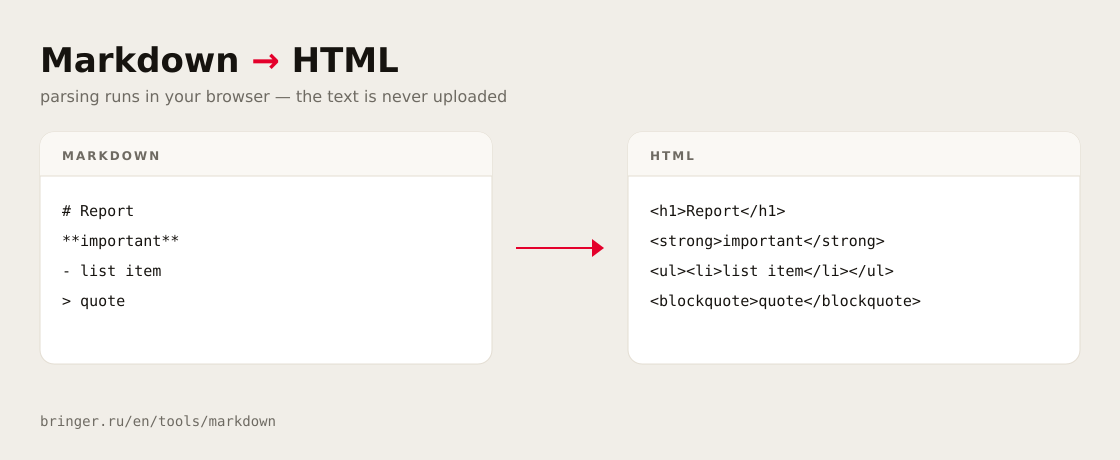
Markup on the left, the finished page on the right. Switch to code and take clean HTML: a fragment for your CMS or a standalone file with styles inlined.
Parsing runs in your browser — the text is never sent to a server
hover a line — its counterpart lights up in the other pane
Layout
Markdown
Characters845
Words154
Headings5
Code blocks1
1.6 KB · fragment
Quarterly report
A short document showing every basic construct: italic, code,
strikethrough and a link to the tools.
What we did
moved the catalogue to the new template
added three text tools
case converter
typographer
fixed the CSV export
Plan for the month
Markdown → HTML
Syntax highlighting
Import from Notion
collect the requirements
build the page
Markup has to stay readable without any software at all.
That is the main rule of Markdown.
Table
Tool
Runs
Share
Typographer
12,400
31 %
Case
8,900
22 %
QR codes
5,100
13 %
Code
const html = md.render(source);
document.body.innerHTML = html;
Details are on the and in the email.
480 px
02
Export
what lands in the clipboard and in the downloaded file
03
Syntax
click a row — it is appended to the editor
04
Frequently asked questions
Paste your markup into the left pane and the result appears on the right immediately — there is no «Convert» button. Then pick what to take away: «Preview» shows the rendered page, «HTML» shows the code itself, «Contents» lists every heading with its anchor. One button copies the result, the other downloads it as a file. Everything runs in the browser.
A fragment is content tags only — headings, paragraphs, lists. You paste it into a site template, a CMS editor or an email, where the page wrapper already exists. A full document adds the doctype, charset, page title and optionally styles, so the file opens in a browser on its own. The «Full document» switch in the Export section decides which one you get.
By default source tags are turned into plain text: foreign markup must not be able to break the layout or inject a script. If the markup is yours and you trust it, turn on «Pass HTML through» and the tags reach the output untouched. The tool warns you right under the switches — whatever passes through includes the contents of a script tag.
Copy the preview, not the code: select the rendered block with the mouse and paste it into the document. Headings, lists, tables and emphasis keep their formatting, and code blocks stay monospaced. Pasting the HTML code instead makes the editor show the tags as ordinary text — that is the most common reason people think the converter failed.
They power in-page links and the table of contents: `#what-we-did` jumps straight to that section. The id is built from the heading text, Cyrillic is transliterated, and repeated headings get a numeric suffix — a second «What we did» becomes `what-we-did-2`. If you do not need anchors, switch off «Heading ids» and the headings stay clean.
No. The markup is parsed and the HTML assembled inside the tab; no network request is made while you type, copy or download — the file is built in the browser too. That matters more than it sounds: converters like this usually get draft articles, internal notes and documents that have no business sitting on someone else's server.
 and in the email.